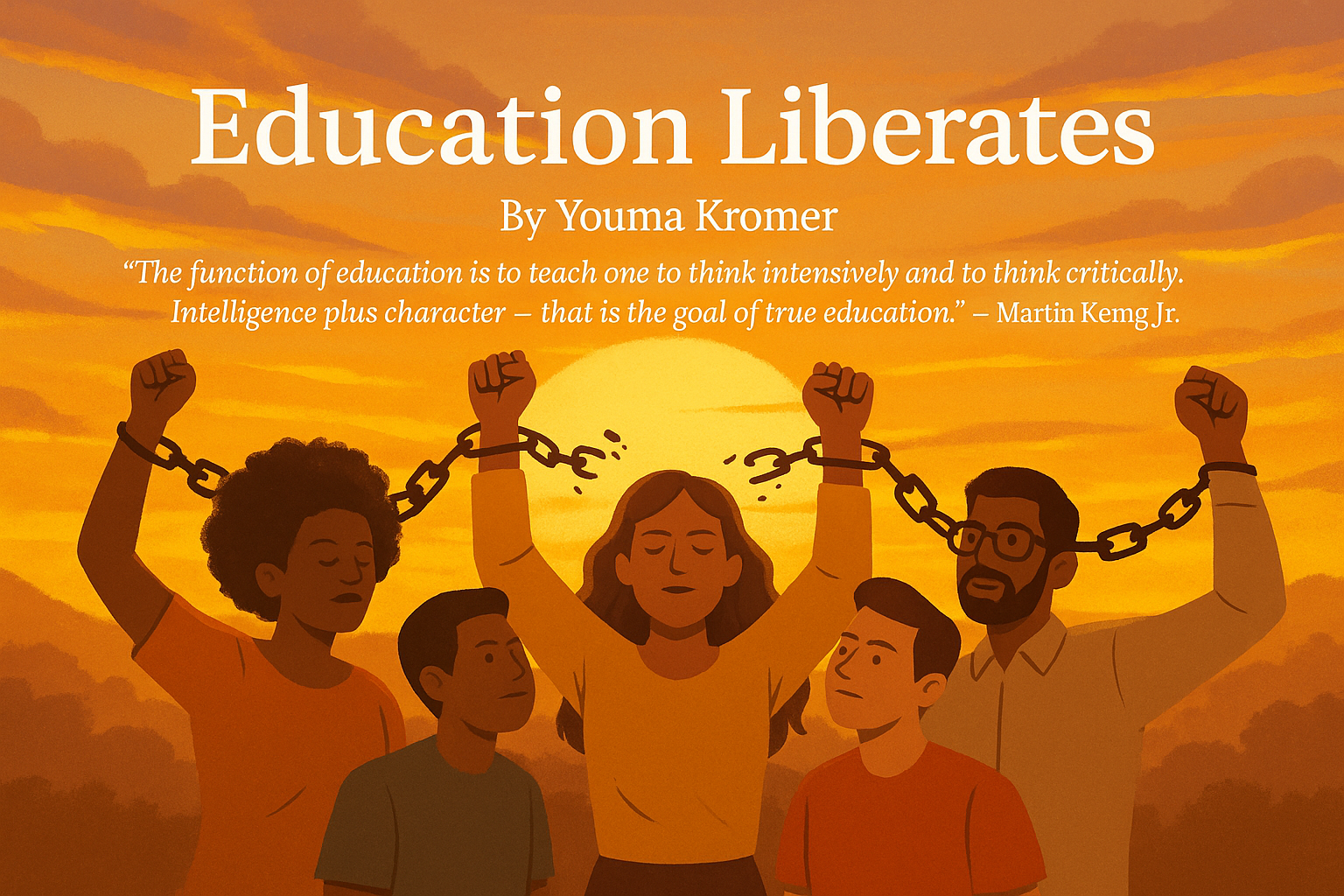
By Youma Kromer
“The function of education is to teach one to think intensively and to think critically. Intelligence plus character — that is the goal of true education.” — Martin Luther King Jr.
The Architecture of Our Minds
Education is not merely a tool, it is the architecture of our minds. From the moment we step into a classroom, our thoughts are quietly shaped by the narratives, facts, as well as the untold that are built into the curriculum.As Carter G. Woodson said, “If you can control a man’s thinking, you don’t have to worry about his actions.”
Consider a simple test of recall: when the word Africa arises, which images surface first—wildlife, sweeping landscapes, poverty? Generic associations. Likewise, when asked to name ancient civilizations, most will cite Rome or Greece (perhaps Egypt). This pattern reflects not objective reality, but what curricula and media have trained us to remember—and what they have taught us to overlook.
But where are the glorious empires of Mali, Ghana, or the intellectual brilliance of Timbuktu? Their absence is not a coincidence; its design. History is not only remembered — it is curated. When stories are omitted, they are slowly buried beneath louder narratives, until they no longer exist in the collective imagination.
Erasure doesn’t begin when we forget. It begins when we are never taught to remember.
Education: Key or Weapon ?
Education has always carried two faces: it can be a key that unlocks possibility, or a weapon that quietly controls. Too often, what we call “education” doesn’t teach us how to think — it tells us what to believe.
Real learning begins where obedience ends: when we challenge what we’ve inherited, when we ask harder questions than the ones we are given. In an age where algorithms dictate what we see and artificial intelligence can shape what we trust, truth no longer simply lands in our hands — it must be sought, protected, and earned. Education must be interrogated, not consumed.
Listening then becomes the sharpest tool of any true learner: listening to the voices’ history pushed to the margins, to the stories buried beneath the noise. Real education happens when we open our ears wider than our mouths, when we choose to sit with the untold and the uncomfortable.
As Nelson Mandela once said, “Education is the most powerful weapon which you can use to change the world.” But a weapon is only as just as the hands that hold it — and hands that cannot listen will never build a world worthy of truth.
The Willingness to Confront
There is a dangerous comfort in never questioning, a soft, quiet ignorance that disguises itself as certainty. I have lived in that comfort too. But each day, I try to lean into the discomfort of asking, unlearning, and seeing beyond what was handed to me.
Education is not about perfection. It is about willingness — the willingness to face the histories that are hard to face: colonialism, exploitation, erasure, and the systems that persist today because we are too afraid, or too comfortable, to question them. Confronting history is not about guilt. It’s about courage. Courage to look straight at the truth and still choose to build something better.
Education is liberating. But liberation is not inevitable. It is a deliberate, daily act of refusal against easy ignorance.
So let us be that someone.
Let us carry our power with care.Let us teach with love, listen with grace, and speak bravely.